JEE Main Chapter Wise Weightage Physics 2027: High-Weightage Chapters, Table and Free MCQs
Physics carries 100 of the 300 marks in JEE Main Paper 1, and a unit that brings three questions is worth 12 marks. Before you open a single module, you need to know where those questions come from. This guide gives you the JEE Main chapter wise weightage physics 2027 picture in one place: a unit-wise table built on the JEE Main 2026 papers, a Class 11 and Class 12 split, a tiered revision order and a free practice set.
Quick answer: NTA has not published any chapter-wise weightage for 2027, so this guide uses the latest full paper data, which is 2026. In 2026, Current Electricity and Magnetic Effects of Current with AC each brought about three questions per paper. Modern Physics brought two to three. Electrostatics, Heat and Thermodynamics, Ray Optics and Kinematics brought two each. Those seven units supplied about 70 percent of the tracked physics questions. Read every figure as a planning guide, not a promise.
Key Takeaways
- In the JEE Main chapter wise weightage physics 2027 analysis, three units (Current Electricity, Magnetic Effects of Current and AC, Modern Physics) supply roughly 36 percent of the tracked questions.
- Class 12 units supplied about 57 percent of the tracked questions in 2026 and Class 11 units about 43 percent, so you cannot skip either year.
- The five-year view shows most units holding steady. Current Electricity, Ray Optics and Kinematics moved up in 2026.
- Low-weightage units still bring one question each, and all five numerical-value questions are compulsory. Revise them briefly, but never drop them.
JEE Main 2027 Physics at a Glance
Before you rank units, look at the paper they feed. The table below follows the official NTA information bulletin for JEE Main 2027.
| Particular | JEE Main 2027 physics (NTA bulletin) |
| Questions | 25 in total: 20 multiple-choice (Section A) and 5 numerical-value (Section B) |
| Marks | 100 out of 300 in Paper 1, with equal weightage for Physics, Chemistry and Mathematics |
| Marking | +4 for a correct answer, −1 for a wrong answer in Section A and Section B, 0 if you skip |
| Duration | 3 hours for Paper 1, computer-based test |
| Shifts | 9:00 AM to 12:00 noon and 3:00 PM to 6:00 PM IST |
| Session 1 | January 20, 21, 22, 23, 24 and 28, 2027 |
| Session 2 | April 2, 3, 4, 5, 6 and 7, 2027 |
| Medium | 13 languages, with the English version prevailing if the versions differ |
Physics holds 25 of the 75 questions in Paper 1, and each question is worth 4 marks. Read the full JEE Main exam pattern for the other papers and the tie-breaking rules. The bulletin states that a wrong answer costs one mark in both sections, so a calculated skip often beats a blind guess. Our JEE Main 2027 exam dates page tracks the full schedule for both sessions.
NTA publishes the detailed physics syllabus on its website, and reports on the 2027 syllabus describe 20 physics units from Class 11 and Class 12 with no change from 2026. You can go through every topic in our JEE Main syllabus guide.
Does NTA Publish Official Chapter Wise Weightage for Physics?
No. The 2027 information bulletin states only that Mathematics, Physics and Chemistry carry equal weightage, with 25 questions each. It gives no split by chapter or unit. Every weightage table online comes from someone analysing past papers, and this one is no exception.
Here is how our JEE Main chapter wise weightage physics 2027 table works. We took the latest paper year with full data, which is 2026, and used the average number of physics questions each unit brought to a 25-question paper. Where the source gives a range, such as two to three questions, we used the midpoint to work out each unit’s share. The tracked units add up to about 23.5 questions in an average paper. The other one or two questions come from chapters the source does not break out. For the syllabus and any rule change, always confirm on the official NTA website, jeemain.nta.nic.in.
JEE Main Chapter Wise Weightage Physics 2027: Unit-Wise Table Based on 2026
The table ranks 13 physics units by their 2026 question count per paper. Tier 1 means 2.5 or more questions per paper, Tier 2 means 2, Tier 3 means 1.5, and Tier 4 means 1. The “Chapters inside the unit” column shows which NCERT chapters sit under each unit.
| # | Unit | Class | Chapters inside the unit | Qs per paper | Share | Priority |
| 1 | Current Electricity | 12 | Current, resistance, circuits, Kirchhoff’s laws, meter bridge, potentiometer | 3 | 12.8% | Tier 1 |
| 2 | Magnetic Effects of Current and AC | 12 | Moving Charges and Magnetism, Magnetism and Matter, Electromagnetic Induction, Alternating Current | 3 | 12.8% | Tier 1 |
| 3 | Modern Physics | 12 | Dual Nature of Radiation and Matter, Atoms, Nuclei | 2–3 | 10.6% | Tier 1 |
| 4 | Electrostatics and Capacitance | 12 | Electric Charges and Fields, Electrostatic Potential and Capacitance | 2 | 8.5% | Tier 2 |
| 5 | Heat, Thermodynamics and KTG | 11 | Thermodynamics, Kinetic Theory of Gases | 2 | 8.5% | Tier 2 |
| 6 | Ray Optics and Optical Instruments | 12 | Reflection, refraction, lenses, prisms, optical instruments | 2 | 8.5% | Tier 2 |
| 7 | Kinematics | 11 | Motion in a Straight Line, Motion in a Plane, projectile motion | 2 | 8.5% | Tier 2 |
| 8 | Rotational Motion | 11 | Torque, moment of inertia, angular momentum, centre of mass | 1–2 | 6.4% | Tier 3 |
| 9 | Work, Energy, Power and Laws of Motion | 11 | Newton’s laws, friction, work-energy theorem, power, collisions | 1–2 | 6.4% | Tier 3 |
| 10 | Gravitation | 11 | Gravitational force and potential, satellites, escape velocity | 1 | 4.3% | Tier 4 |
| 11 | Units, Dimensions and Errors | 11 | SI units, dimensional analysis, significant figures, errors | 1 | 4.3% | Tier 4 |
| 12 | Semiconductor Electronics | 12 | Diodes, rectifiers, transistors, logic gates | 1 | 4.3% | Tier 4 |
| 13 | Oscillations and Waves | 11 | Simple Harmonic Motion, wave motion, sound | 1 | 4.3% | Tier 4 |
Qs per paper shows the 2026 range across shifts. Share divides each unit’s midpoint by the 23.5 tracked questions. A unit’s count can swing by a question from shift to shift.
Current Electricity moved from two questions in earlier years to three in 2026, which makes it the single most reliable unit to master. Magnetic Effects of Current and AC held at three, and it bundles four NCERT chapters, so it rewards careful revision.
The chart below shows the same 2026 data. The darkest bars are Tier 1.
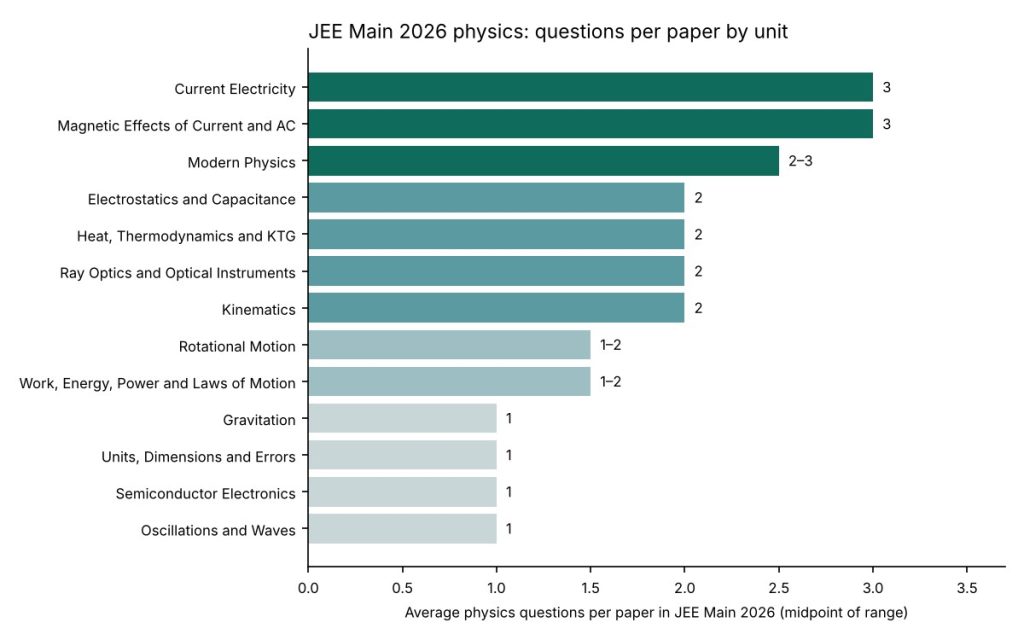
Figure 1: Average physics questions per paper by unit, JEE Main 2026.
Five-Year Trend: How Stable Is Physics Weightage?
One year of data can mislead, so compare it with the earlier years. The table shows physics questions per paper for each unit from 2022 to 2026.
| Unit | 2022 | 2023 | 2024 | 2025 | 2026 |
| Current Electricity | 2 | 2 | 2 | 2 | 3 |
| Magnetic Effects of Current and AC | 2 | 3 | 2–3 | 2–3 | 3 |
| Modern Physics | 3 | 3 | 2–3 | 3 | 2–3 |
| Electrostatics and Capacitance | 2 | 2 | 2 | 2 | 2 |
| Heat, Thermodynamics and KTG | 2 | 2 | 2 | 2 | 2 |
| Ray Optics and Optical Instruments | 1 | 1 | 1 | 1–2 | 2 |
| Kinematics | 1 | 1 | 1 | 1–2 | 2 |
| Rotational Motion | 1 | 1 | 1 | 1 | 1–2 |
| Work, Energy, Power and Laws of Motion | 1 | 1 | 1 | 1 | 1–2 |
| Gravitation | 1 | 1 | 1 | 1 | 1 |
| Units, Dimensions and Errors | 1 | 1 | 1 | 1 | 1 |
| Semiconductor Electronics | 1 | 1 | 1 | 1 | 1 |
| Oscillations and Waves | 1 | 1 | 1 | 1 | 1 |
Three patterns stand out. Electrostatics and Heat with Thermodynamics stayed at two questions every year. Modern Physics stayed at two or three. Ray Optics and Kinematics rose from one question to two in 2026, and Current Electricity rose from two to three. Because the core units barely moved across five papers, the 2026 ranking is a sound guide for 2027, although NTA can change the mix at any time.
What the April 2026 Shift Reports Add
Shift-wise analyses of the April 2026 papers back up the unit table. Reviewers of the second shift on April 2 listed Electromagnetic Waves, Thermodynamics and Modern Physics among the high-weightage topics, and reviewers of the first shift pointed to Ray Optics, Thermodynamics, Electromagnetism and Modern Physics. Analysts also noted a slight tilt toward Class 12 topics across the three subjects. These reports are qualitative, so use them as supporting evidence, not as exact counts.
High Weightage Chapters for JEE Mains Class 11 Physics
Class 11 units supplied about 43 percent of the tracked 2026 questions. These units carry most of that weight:
- Heat, Thermodynamics and KTG (2 questions). Master the first law, work done on PV diagrams, isothermal and adiabatic processes, heat engine efficiency and the kinetic theory relations.
- Kinematics (2). Practise relative motion, projectile motion and graph-based questions in one and two dimensions.
- Rotational Motion (1 to 2). Cover torque, moment of inertia, rolling motion and conservation of angular momentum. Apply the parallel and perpendicular axis theorems until they feel automatic.
- Work, Energy, Power and Laws of Motion (1 to 2). Use the work-energy theorem, variable forces, friction and collisions.
- Gravitation, Units and Errors, and Oscillations and Waves (1 each). Learn orbital and escape velocity, dimensional analysis with error propagation, and the standard SHM and wave equations.
Class 11 chapters outside these units, such as fluids and thermal properties, can still appear in the remaining one or two questions per paper, so keep short notes on them.
High Weightage Chapters for Class 12 Physics
Class 12 units supplied about 57 percent of the tracked 2026 questions. Electricity, magnetism and modern physics dominate.
- Current Electricity (3). Practise Kirchhoff’s laws, the meter bridge, the potentiometer and resistor colour codes.
- Magnetic Effects of Current and AC (3). Work through the force on moving charges, the Biot-Savart law, Ampere’s law, Faraday’s law and Lenz’s law, and LCR circuits with resonance and power.
- Modern Physics (2 to 3). Focus on the photoelectric effect, de Broglie wavelength, Bohr model transitions and nuclear binding energy.
- Electrostatics and Capacitance (2). Use Gauss’s law, field and potential calculations, and capacitors with dielectrics.
- Ray Optics and Optical Instruments (2). Solve lens and mirror formula questions, refraction at spherical surfaces, prisms and magnification of microscopes and telescopes.
- Semiconductor Electronics (1). Learn diodes, rectifiers, transistors and logic gates. Many of these questions are conceptual and quick once you know the circuits.
Most Important Chapters for JEE Mains Physics 2027: A Four-Tier Study Plan
Tier 1: Master these first (3 units, about 36 percent of questions)
Current Electricity, Magnetic Effects of Current and AC, and Modern Physics. Give them your longest study sessions, your first full revision pass and your biggest bank of previous-year questions.
Tier 2: Build these next (4 units, about 34 percent)
Electrostatics and Capacitance, Heat with Thermodynamics and KTG, Ray Optics and Optical Instruments, and Kinematics. Aim for strong concepts first, then timed numerical practice.
Tier 3: Revise with focus (2 units, about 13 percent)
Rotational Motion, and Work, Energy, Power with Laws of Motion. Write a one-page formula sheet for each and solve one chapter-wise question set.
Tier 4: Keep these alive (4 units, about 17 percent)
Gravitation, Units Dimensions and Errors, Semiconductor Electronics, and Oscillations and Waves. Read the NCERT summary, learn the key formulas and attempt a few questions. All five numerical-value questions are compulsory, so a unit you ignore can cost you direct marks.
JEE Main Chapter Wise Weightage Physics 2027 PDF and Free Resources
Students often search for a weightage of chapters in JEE Mains 2027 PDF. NTA does not release one, and the files that circulate online are unofficial summaries, much like this table. You can keep this guide for free: press Ctrl+P (Cmd+P on a Mac), choose Save as PDF, and the full tables stay on your phone or laptop.
Before you trust any downloaded file, check three things. Does it name the years it analysed? Does it say how it groups chapters? Does it match the current NTA syllabus? If the answer to any of these is no, treat the file as a rough opinion.
Most Important Chapters for JEE Mains Physics 2026 and Why They Still Matter
Many students also look for the most important chapters for JEE Mains Physics 2026 or a JEE Mains weightage chapter wise 2026 PDF. The 2026 papers are the base of this whole guide, because they are the latest full set before 2027. The five-year table above shows that the high-yield units barely changed from 2022 to 2026. That stability is the strongest reason to trust the tiers, but let the current NTA syllabus decide what you study.
JEE Main Chapter Wise Weightage Physics 2027 MCQ: Free Practice Set
Test yourself on six questions from the high-priority units. Cover the answers, give each question about two minutes, then check your reasoning against the explanation.
Q1. A particle of mass m and charge q enters a uniform magnetic field B at right angles with speed v. The time period of its circular motion is
(A) mv/(qB)
(B) 2πm/(qB)
(C) 2πmv/(qB)
(D) qB/(2πm)
Answer: (B). The magnetic force supplies the centripetal force, so qvB = mv²/r and r = mv/(qB). The period is T = 2πr/v = 2πm/(qB), and it does not depend on speed. Unit: Magnetic Effects of Current and AC.
Q2. A thin ring of mass M and radius R lies in a plane. Its moment of inertia about a tangent in that plane is
(A) 3MR²/2
(B) MR²
(C) 2MR²
(D) MR²/2
Answer: (A). About a diameter the ring has I = MR²/2. The parallel axis theorem adds MR² for the tangent: MR²/2 + MR² = 3MR²/2. Unit: Rotational Motion.
Q3. A convex lens of focal length 20 cm forms a real image of an object placed 30 cm from it. The image distance is
(A) 12 cm
(B) 20 cm
(C) 30 cm
(D) 60 cm
Answer: (D). Use 1/v − 1/u = 1/f with u = −30 cm and f = 20 cm. Then 1/v = 1/20 − 1/30 = 1/60, so v = 60 cm. Unit: Ray Optics and Optical Instruments.
Q4. A battery stays connected to a parallel plate capacitor while a dielectric of constant K fills the gap completely. The stored energy becomes
(A) unchanged
(B) K times the original
(C) 1/K times the original
(D) K² times the original
Answer: (B). The voltage stays fixed while the capacitance rises to KC. Energy = ½(KC)V², so it grows K times. Unit: Electrostatics and Capacitance.
Q5. An electron accelerates from rest through a potential difference of 150 V. Its de Broglie wavelength is closest to
(A) 0.1 Å
(B) 10 Å
(C) 1 Å
(D) 100 Å
Answer: (C). λ ≈ 12.27/√V Å, so λ ≈ 12.27/√150 ≈ 1.0 Å. Unit: Modern Physics.
Q6. Resistors of 4 Ω and 6 Ω connect in parallel across a 12 V battery of negligible internal resistance. The total current drawn from the battery is
(A) 1.2 A
(B) 2 A
(C) 3 A
(D) 5 A
Answer: (D). The equivalent resistance is (4 × 6)/(4 + 6) = 2.4 Ω. The current is 12/2.4 = 5 A. Unit: Current Electricity.
How to Use Chapter Weightage Without Falling Into Traps
- Start with the tiers, but finish the syllabus. The top seven units supply about 70 percent of tracked questions. The rest still decides your rank.
- Pair weightage with previous-year questions. A unit list tells you where to look; PYQs show you how NTA asks. Our best books for JEE Mains guide lists question banks and PYQ collections for every subject.
- Track accuracy by unit. After each test, log how many questions you attempted, solved correctly and got wrong in each unit. Your own log beats any published table.
- Balance both classes. Class 12 carries more weight, but Class 11 units such as Heat and Thermodynamics and Kinematics sit in Tier 2.
For a full plan across all three subjects, read our guide on how to prepare for JEE Main 2027.
FAQs on JEE Main Physics Chapter Wise Weightage
Which chapters have the highest weightage in JEE Main physics 2027?
Based on the 2026 papers, Current Electricity and Magnetic Effects of Current with AC lead with about three questions each per paper. Modern Physics follows with two to three. NTA has not announced chapter weightage for 2027, so this ranking rests on past papers.
Does NTA release an official chapter wise weightage PDF for physics?
No. The NTA information bulletin gives equal weightage to Physics, Chemistry and Mathematics and nothing finer. Any weightage PDF you find online is an unofficial analysis, so check which years it covers before you rely on it.
How many questions come from each physics unit?
Most units bring one or two questions to a 25-question paper. Current Electricity and Magnetic Effects with AC reached three in 2026, while Gravitation, Units and Errors, Semiconductor Electronics and Oscillations and Waves stayed at one.
Which Class 11 physics chapters matter most for JEE Main?
Heat and Thermodynamics, Kinematics, Rotational Motion, and Work, Energy, Power with Laws of Motion carry the most weight in Class 11.
Can I score well by studying only high-weightage chapters?
No. The top seven units supply about 70 percent of tracked questions, which leaves a large share elsewhere, and numerical-value questions are compulsory. Prioritise the high-weightage units first, then cover the rest.
Does Class 11 or Class 12 carry more weight in JEE Main physics?
Class 12 carries more. In the 2026 unit data, Class 12 units supplied about 57 percent of tracked questions and Class 11 units about 43 percent.
Final Thoughts
The JEE Main chapter wise weightage physics 2027 data points to a clear plan. Master Current Electricity, Magnetic Effects of Current with AC, and Modern Physics first. Work through the Tier 2 units next, and keep every other unit alive with short notes and a few previous-year questions. Use the table as a map, not a promise.
Open the syllabus, take your first mock test and log your accuracy unit by unit. That log will show you exactly where your marks still hide.
Data notes: Exam pattern, marking scheme, shift timings and session dates follow the NTA JEE (Main) 2027 information bulletin. NTA does not publish chapter-wise weightage. Physics questions per paper for 2022 to 2026 come from a published unit-wise analysis of those papers, and we calculated the shares, tiers and class split from its 2026 column. April 2026 shift observations come from published shift analyses. Weightage varies by shift and session.